Diastasis Recti Exercises: What's Safe After Pregnancy
Diastasis Recti Exercises: What's Safe After Pregnancy
Learn which diastasis recti exercises are safe postpartum, when to start core work, and how to rebuild your strength after pregnancy with evidence-based guidance.
Can I Do Core Exercises After Pregnancy with Diastasis Recti?
If you're dealing with abdominal separation after pregnancy, you've probably heard conflicting advice about which exercises are safe. Some sources say avoid all ab work, while others promise their method will "close your gap." So what does the evidence actually say about diastasis recti exercises?
The reality is more nuanced and more hopeful than many online sources suggest. Most women can safely rebuild core strength after pregnancy, but it requires a gradual, symptom-guided approach rather than strict avoidance of all abdominal work.
What the Evidence Says About Diastasis Recti
Diastasis recti (abdominal muscle separation) is extremely common. Research shows around 60% of women have a measurable gap at six weeks postpartum, dropping to roughly 45% at six months and 33% by twelve months.[2,5,21,25] Most persistent cases are mild rather than severe.
There's no universally agreed number of "fingers" that defines a problem. While two fingerbreadths (about 2 cm) is often used in research as a threshold, what matters more than width alone is tension quality, depth, and whether you're experiencing symptoms.[2,9,12,21]
Exercise can reduce the inter-recti distance by small to moderate amounts and improve strength and symptoms, though results vary between studies.[3,4,5,6,7] Importantly, a persistent gap can still be compatible with a strong, functional core. Evidence linking diastasis width with back pain or pelvic floor problems is weak or inconsistent.[2,5,9,13,19]
For most postpartum women, graded core and pelvic floor training with attention to breathing and pressure management is considered safe and is recommended over strict avoidance of all ab exercises.[1,3,5,8,10,11]
What You Can Try: Safe Core Exercises for Diastasis Recti
Start with low-load, breath-led core work early. Within the first one to two weeks postpartum (when medically cleared), you can typically begin gentle diaphragmatic breathing, pelvic floor activation and relaxation, and light transversus abdominis work like pelvic tilts, heel slides, and supported side-lying exercises.[1,8,10,11]
Progress gradually based on symptoms. Introduce harder tasks stepwise: longer lever arms, anti-rotation work, loaded carries, and eventually planks or crunches. The key is whether you can maintain midline tension, breathe comfortably, and avoid doming or bulging at the belly.[1,3,5,8,11]
Traditional ab exercises aren't universally off limits. Mini-crunches, modified planks, and dead-bug variations may be appropriate when you can control pressure and maintain tension. There's no strong evidence that these exercises, when appropriately dosed, worsen diastasis.[1,3,4,6,7,22]
Watch your global load, not just isolated ab work. Heavy lifting, high-impact activities, or intense core classes should wait until foundational strength and pressure management are solid. Consider screening for pelvic floor symptoms before returning to running or high-impact sports.[1,5,11,27]
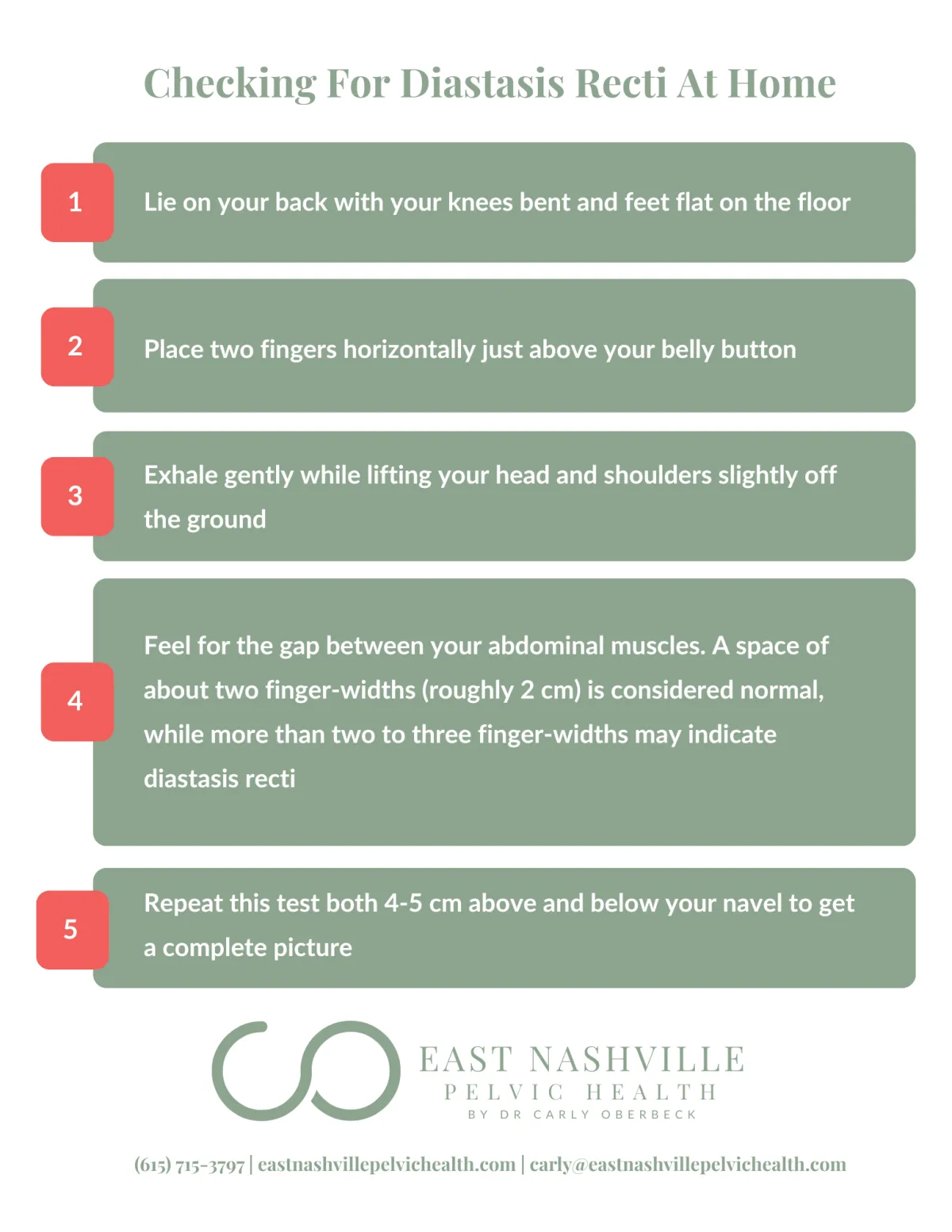
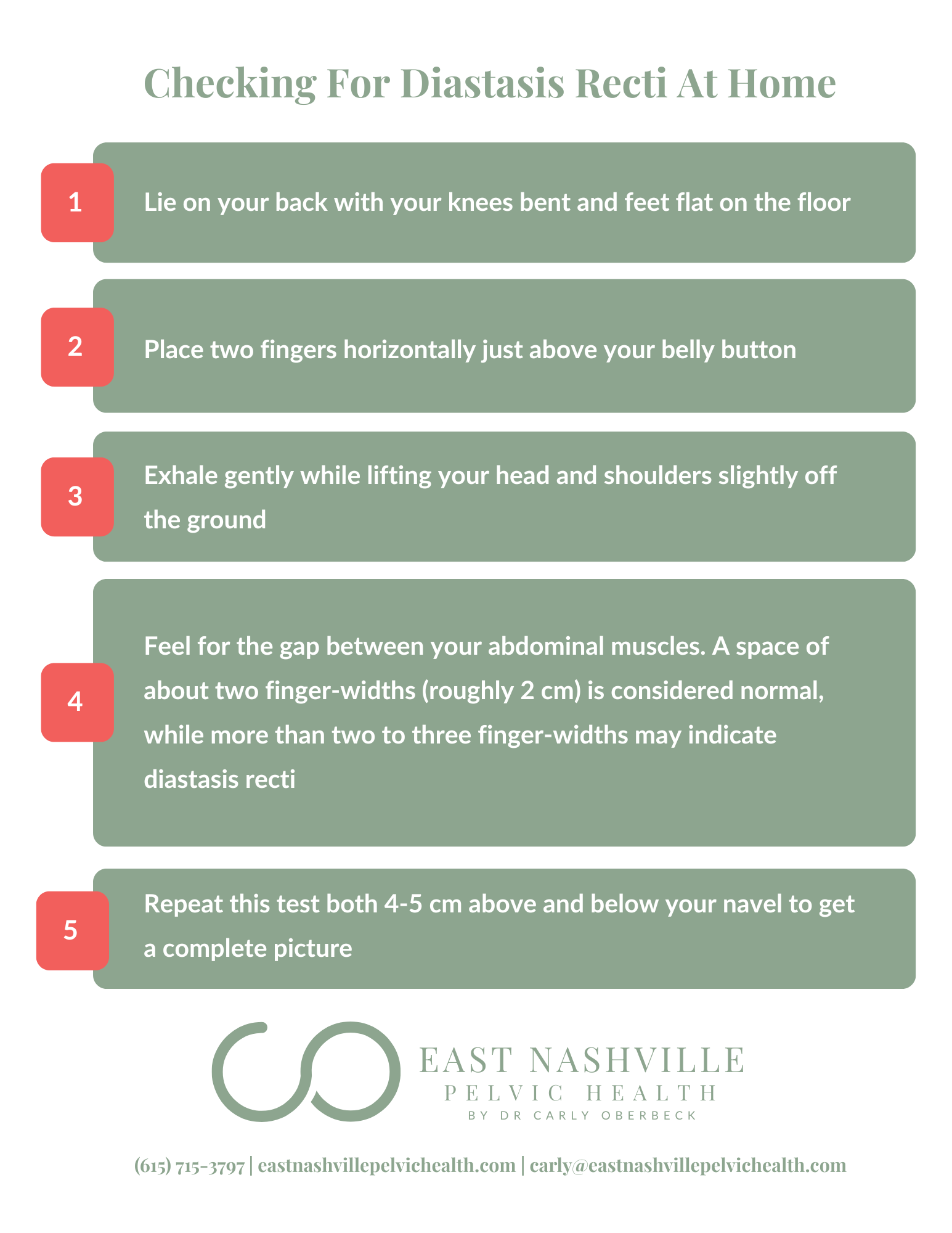
Self-checks can help, but prioritize function over finger-width. Lie on your back, gently lift your head, and palpate your midline. Use this only as a screen. Your exercise decisions should be based on tension quality, doming, pain, leaking, or heaviness rather than just how many fingers fit in the gap.[2,8,9,12]
When to See a Pelvic Health PT in East Nashville
A pelvic health physical therapist can measure your inter-recti distance, assess depth and tension, test abdominal strength, and screen pelvic floor function to individualize your loading plan.[8,11,16,23] This personalized guidance helps you progress safely and efficiently without guesswork.
If you're experiencing pain, bulging, leaking, or heaviness with daily activities or exercise, skilled assessment is especially valuable. Physical therapy for diastasis recti focuses on building a strong foundation that supports your long-term goals, whether that's returning to running, lifting your toddler without pain, or simply feeling confident in your body again.
At East Nashville Pelvic Health, we specialize in helping perinatal women rebuild their core strength with evidence-based care and true empathy. Book a pelvic PT consult to get started.
FAQs
Q: How long does it take for diastasis recti to heal postpartum?
A: Natural recovery happens over the first year postpartum. Cohort data suggest diastasis prevalence drops by roughly half between six weeks and twelve months, reflecting substantial spontaneous improvement over time.[2,4,5,21,25] Many women see continued progress with appropriate exercise.
Q: Will planks or crunches make my diastasis worse?
A: Not necessarily. When you can maintain midline tension, breathe properly, and avoid doming, traditional ab exercises can be appropriate. The key is gradual progression and symptom-guided loading rather than blanket avoidance.[1,3,4,6,7,22]
Q: Do I need surgery to fix diastasis recti?
A: Most women don't need surgery. Exercise-based rehabilitation improves strength and symptoms for many people. Surgery is typically reserved for severe cases with hernias or significant functional limitations. A pelvic health PT can help you determine the best path forward.
Evidence last reviewed: December 8, 2025
References
ACOG Committee Opinion No. 804. Physical activity and exercise during pregnancy and the postpartum period. Obstet Gynecol. 2020;135(4):e178-e188. https://doi.org/10.1097/AOG.0000000000003772
Sperstad JB et al. Diastasis recti abdominis during pregnancy and 12 months postpartum: prevalence, risk factors and lumbopelvic pain. Br J Sports Med. 2016;50(17):1092-1096. https://doi.org/10.1136/bjsports-2016-096065
Weingerl I et al. The effects of conservative interventions for treating diastasis recti abdominis: a systematic review. Medicine (Baltimore). 2022;101(49):e31910. https://doi.org/10.1097/MD.0000000000031910
Benjamin DR et al. Conservative interventions may have little effect on reducing diastasis of the rectus abdominis in postnatal women: a systematic review and meta-analysis. Physiotherapy. 2023;122:10-21. https://doi.org/10.1016/j.physio.2023.11.004
Beamish NF et al. Impact of postpartum exercise on pelvic floor disorders and diastasis recti abdominis: a systematic review and meta-analysis. Br J Sports Med. 2025;59(8):562-573. https://doi.org/10.1136/bjsports-2024-108345
Gluppe S et al. Effect of a postpartum training program on the prevalence of diastasis recti abdominis in primiparous women: a randomized controlled trial. Phys Ther. 2018;98(4):260-268. https://doi.org/10.1093/ptj/pzy008
Soto-González M et al. Effect of hypopressive and conventional abdominal exercises on inter-recti distance in postpartum women: a randomized trial. PLoS One. 2024;19(7):e0314274. https://doi.org/10.1371/journal.pone.0314274
APTA Pelvic Health. Physical Therapy Guide to Diastasis Rectus Abdominis; Pregnancy & Postpartum Physical Therapy resources. American Physical Therapy Association; 2020–2024. https://www.aptapelvichealth.org/
Du Y et al. Diastasis recti abdominis: a comprehensive review. Hernia. 2025;29(3):1-15. https://doi.org/10.1007/s10029-024-03229-9
NHS. Your post-pregnancy body: exercises and recovery. NHS.uk. 2019. https://www.nhs.uk/pregnancy/labour-and-birth/after-the-birth/your-body-after-pregnancy/
Selman R et al. Maximizing recovery in the postpartum period: a timeline for rehabilitation. Sports Health. 2022;14(5):696-706. https://doi.org/10.1177/19417381211056132
Gluppe S et al. Women with diastasis recti abdominis might have weaker abdominal muscles. Physiother Theory Pract. 2021;37(9):983-993. https://doi.org/10.1080/09593985.2019.1663836
Braga A et al. Is diastasis recti abdominis rehabilitation after childbirth effective? Medicina (Kaunas). 2023;59(12):2182. https://doi.org/10.3390/medicina59122182
APTA. Clinical Practice Guideline: Pelvic girdle pain in the postpartum population. American Physical Therapy Association; 2022. https://www.aptapelvichealth.org/
Chen B et al. Rehabilitations for maternal diastasis recti abdominis: a review of prevalence, risk factors, and treatment. Heliyon. 2023;9(8):e19164. https://doi.org/10.1016/j.heliyon.2023.e19164
(prevalence data composite from references 2 and 5)
(exercise safety composite from references 1, 3, 4, 6, 7)
(assessment guidance from reference 8)
(natural history data from references 2, 4, 5)
(return to activity timeline from references 1, 11)
(early rehab protocols from references 1, 8, 10, 11)
